As mentioned in previous posts, the art of revealing the ongoing ‘invisible’ reactions in my work is key to their understanding and contemplation.
Time lapse video is one method, somewhat related is GIF animation, a method I have just begun to explore.
Timelapse video recording requires a digital camera and artificial lighting, as well as a computer, all fixed in place and permanently powered during the recording process. The requisite technology means the work cannot be easily viewed as in a gallery context.
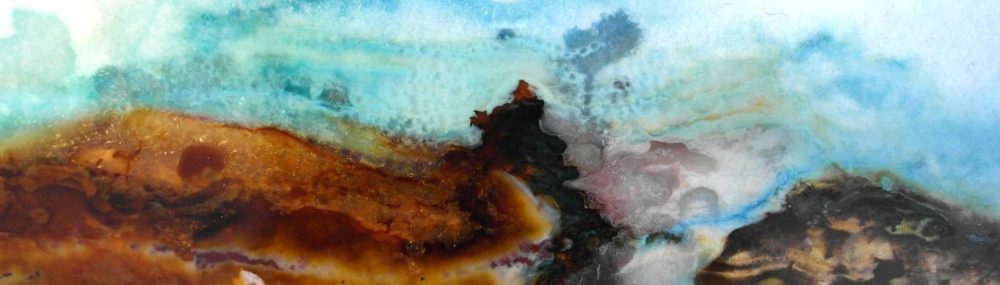
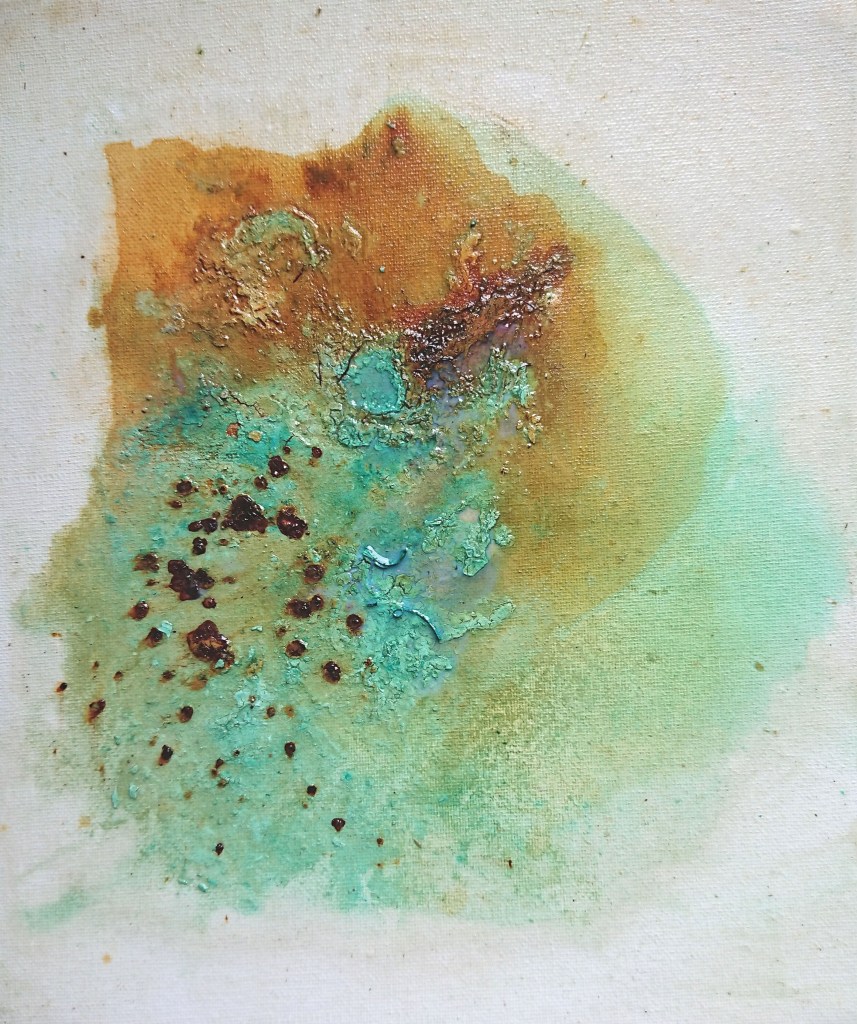
In my #openstudioscornwall2022 exhibition, the relatively new work ‘V3 Reaction’ is developing many intriguing artifacts and changes in form and colour as the electrochemical reactions proceed.
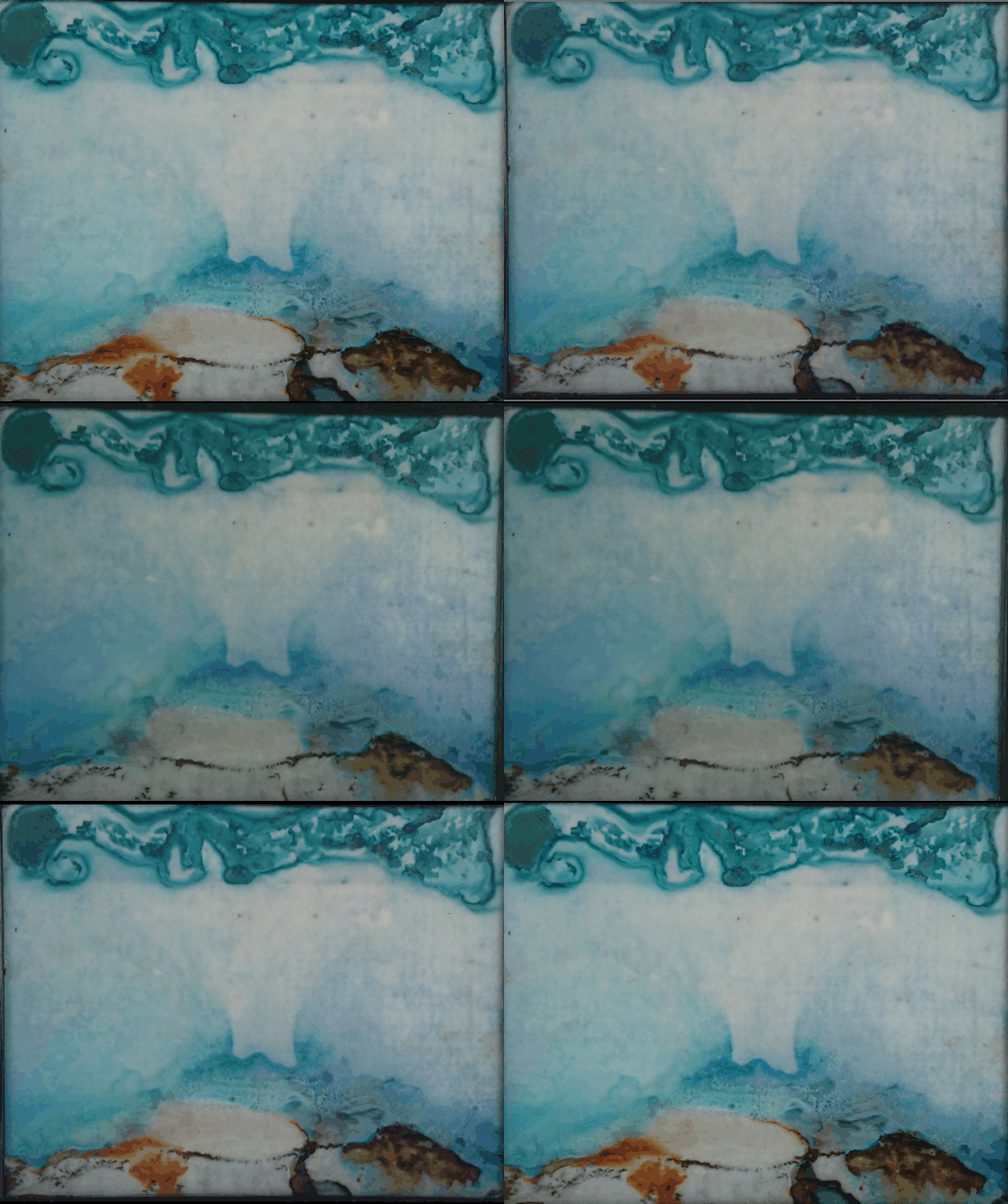
The type of time lapse recording previously used is not feasible in the current gallery context, so I’ve taken to taking a photograph every morning before the show opens. Careful cropping and the use of a gif animation app on my phone is producing a type of time lapse animation where the electrochemical changes are made highly visible, if a little jumpy.
For some time I have been interested in alchemy as a source of creative inspiration and as an ongoing self-reflective process.
After Jung, the gold is within and alchemical processes act upon the world of things and on the more subtle etheric notions within. Processes such as distillation, calcination, dissolution, conjunction and fermentation – described in The Seven Stages of Alchemical Transformation
In 2003 I wrote the paper: Alchemy, mimetics, immersion and consciousness, which was published at MelbourneDAC, the 5th International Digital Arts and Culture Conference, 2003.
“In this paper I discuss a number of ideas on the representation and perception of space, time and energy and how these ideas have been inspirational in creating experiential art works. Areas I have explored include the concept of a fourth dimension, alchemy, mimetics, immersion, artificial-life and ideas about the nature of consciousness. I carry out these explorations through “art as a mode of enquiry”, producing experiential artworks rather than written theory. This paper summarises a number of ideas I have found useful and inspiring in creating artworks that explore the perception and experience of space, time and consciousness.”
19 years later, in 2022 the processes of creation and reflection continue. Notions of Dynamic Form and the Fourth Dimension are imbued in my practice, permeating the work I make.
Today two visitors to my exhibition at #OpenStudiosCornwall2022 pointed out the importance of the timelapse video, that it revealed the unseen and the hidden processes behind two of the works, V1 Reaction and V3 Reaction. This additional knowledge enhanced their appreciation of the work, apparently unmoving and unchanging in the present.
It is not the immediately perceived that is important, but instead it is the mainly invisible time based processes of change and emergence that can only be perceived through the device of memory.
The Electrochemical Glass April 2002 & October 2002
“Our understanding of space-time is shaped by our everyday perceptual mechanisms. Time is perplexing, it is seemingly artiicial and malleable. Hypnosis, meditation, mind-altering substances, mental illness and accidental head injuries reveal how our perception of time may be altered.” (see paper above)
Imagine that we might be able to look at the world where space-time might be altered, slowed down, speeded up, reversed or extrapolated into possible futures.
In my previous post this idea is at the heart of the formation of a new work, one that enables a distant viewer to look at the art work in the present, or wind it back, slow it down, speed it up, look at it moving forwards or backwards in time, or in the current moment, the present, at the very edge of the unfolding of time.
It’s been two years since my last open studio in Cornwall. Since then my efforts to harness the processes of electrochemical reactions for creative expression have developed somewhat.
#openstudioscornwall2022
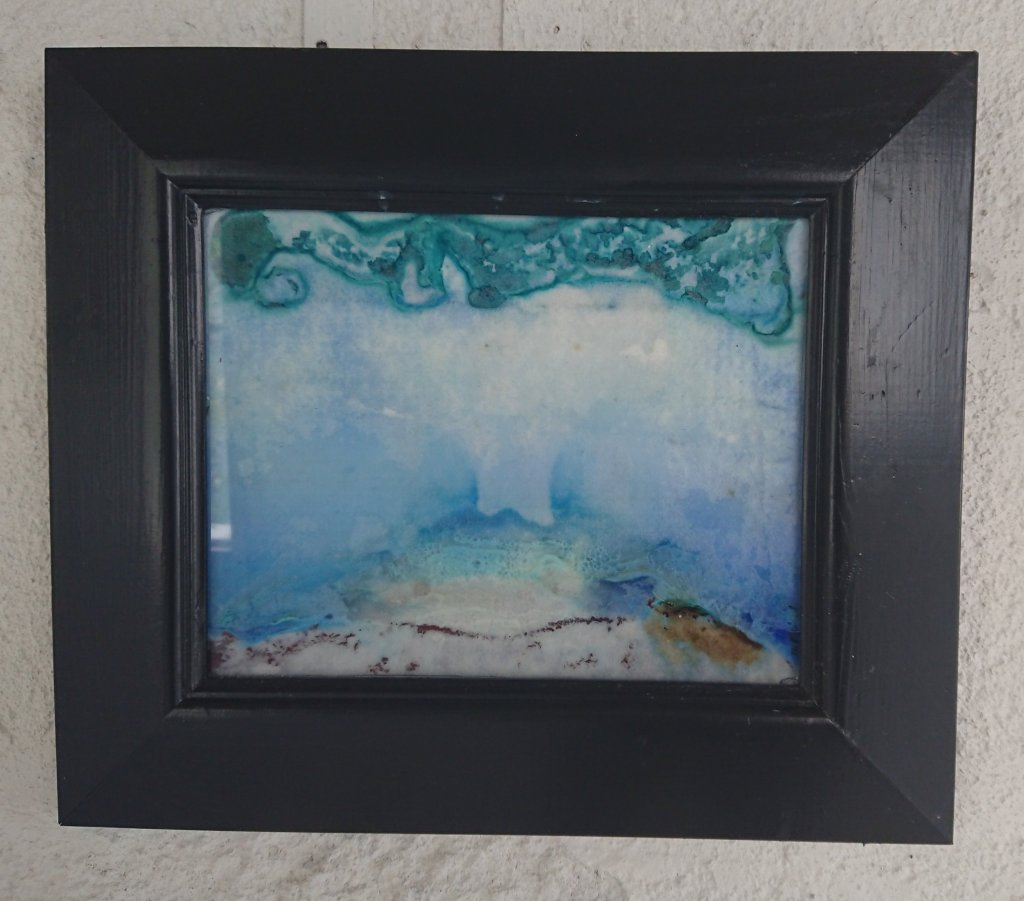
V3 Reaction, commenced 4/5/2022
The repurposing of old picture frames has provided an ideal ‘container’ and means of displaying new works.
Various experiments with metals, materials and solutions have also led to formulae and methods for producing multiples.
V1 Reaction, commenced 22/2/2022
What I find most fascinating and inspiring is how the work develops and evolves over time, no two reactions being the same, producing very different ‘scenes’.
I say scenes as this is the envisaged result, by choosing the appropriate metals and their arrangement and specific solutions, I can create the conditions for emergent reactions that suggest naturalistic landscapes, rock formations, hills and trees, underwater scenes.
Creating a small scale exhibition for a viewing public has also challenged me in how to convey the time based processes that is hidden in a single viewing of a work where the appearance of a work can vary from one day to another.
I gain great pleasure in visiting each work everyday to see how it has changed. Its akin to watching a plant grow, except here there is always an element of surprise, no two reactions ever produce the exact same result.
How to convey this emergent process to a viewer who is seeing the work for the first time with no memory of how it looked when it was first created?
One method that attempts to convey the changing appearance of a work has been the use of digital timelapse, using a Web cam and time lapse software. Below are two short time lapse videos of the works illustrated above, V1 and V3.
Timelapse video of V1 Reaction, 2 minute duration depicting electrochemical reactions over 17 days, 1/4 – 18/4 2022, 1 frame taken every 5 minutes.
Timelapse video of V3 Reaction, 2 minute duration depicting electrochemical reactions over 7 days, 12/5 – 19/5 2022, 1 frame taken every 5 minutes.
The timelapse does illustrate a sample of the electrochemical processing, however it does not have the immediacy or presence of a live viewing.
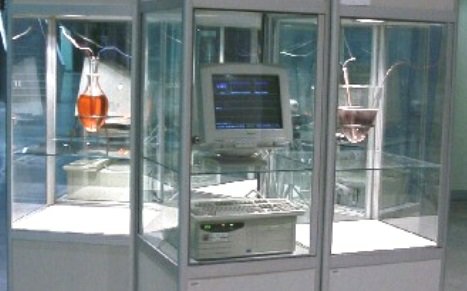
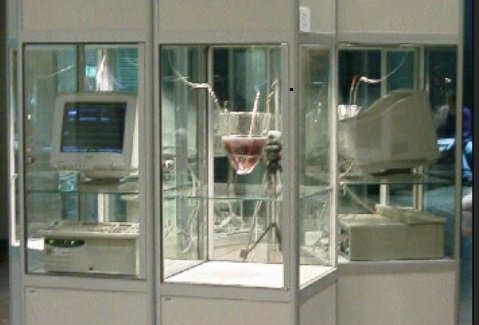
In 2001, during an art residency at CEMA, Monash University, Melbourne, Australia, I created an installation entitled ‘The Preservation of Entropy’.
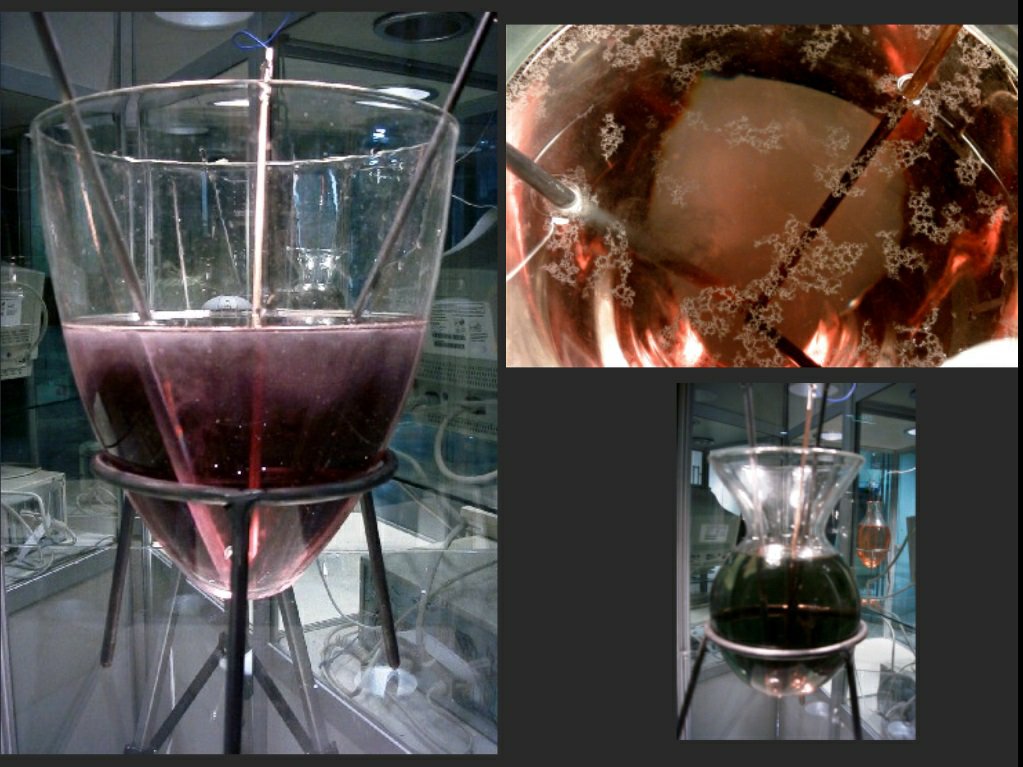
The installation used electrochemical processes to alter three metals (iron, copper, aluminium) in three hand made glass flasks containing three solutions (acid, alkaline, salt).
The three vessels
The reactions generated changing electric signals which were monitored and recorded using bespoke software. The installation was located in a thoroughfare and received regular visitors who would see the work change every day.
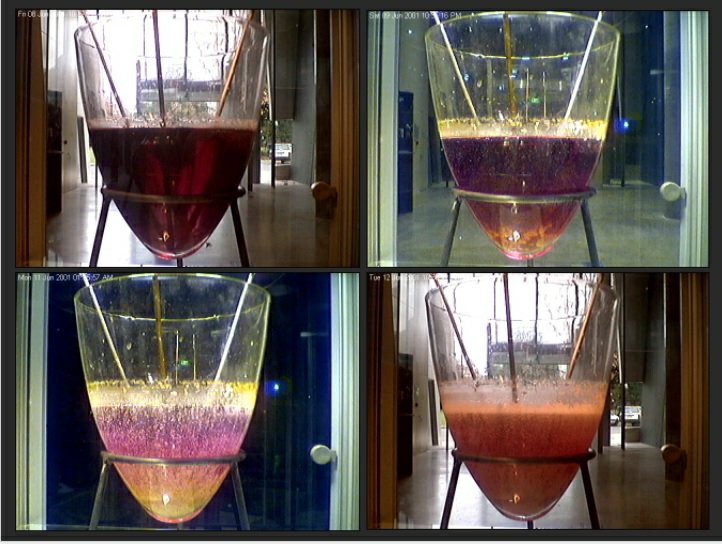
I also wanted to capture and convey the changing processes remotely. To achieve this I used a timelapse technique where a webcam frame of one of the glass vessels was uploaded to a remote server such that people could watch a growing time lapse video, recorded from day one.
Time lapse frames
I am planning on creating a new ‘live installation’ that amalgamates techniques inherent in my recent works with the concept of ‘an electrochemical process time lapse broadcast’ derived from ‘The Preservation of Entropy’.
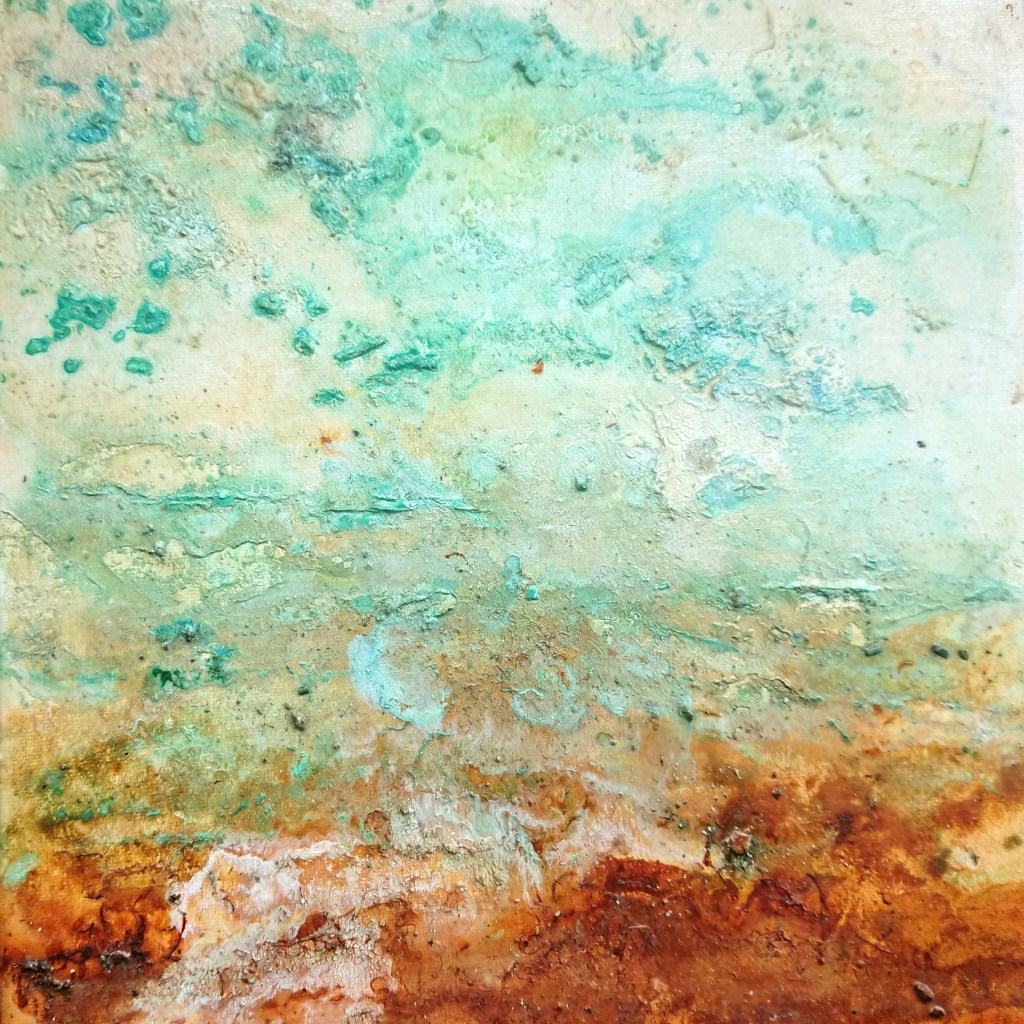
I have recently began experimenting with creating electrochemical landscapes inspired by the sea and minerals of Cornwall.
#openstudioscornwall
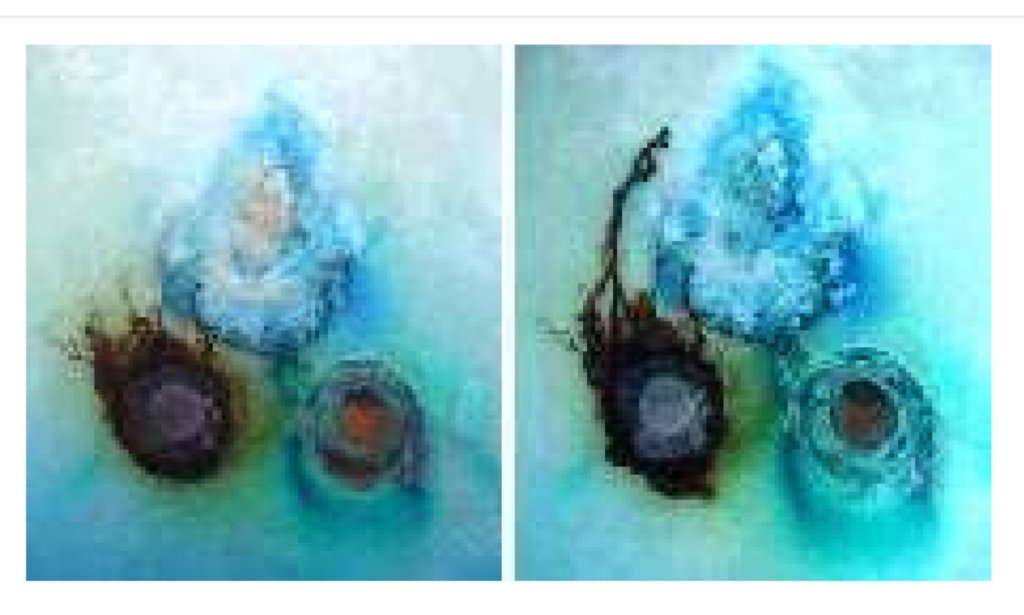
e-scape 01 (30 x 30 x 1.5 cm canvas)e-scape 02 (30 x 30 x 1.5 cm canvas)Ferric Sea (A4 canvas board)
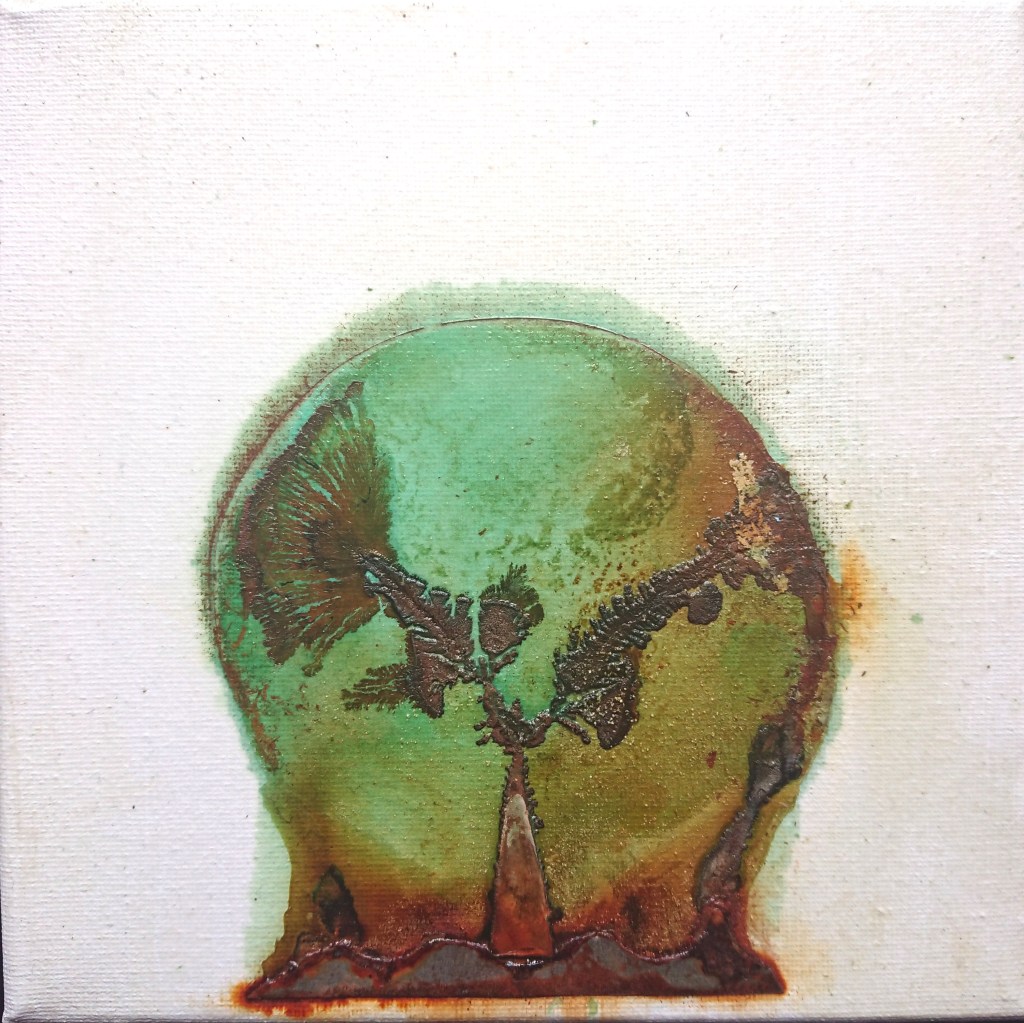
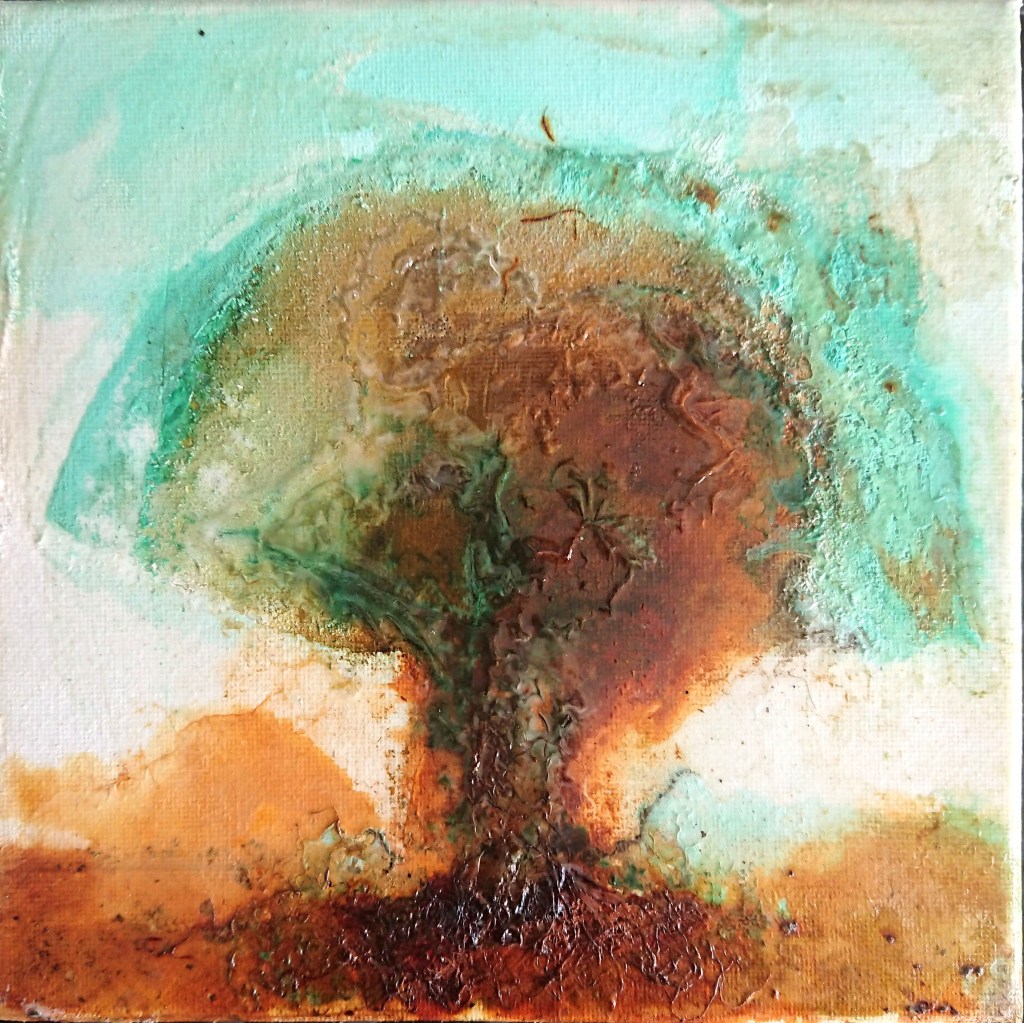
In the process of creating the above works, I discovered a technique for creating tree and fern like forms, which I will use in the creation of further electrochemical landscapes.
Dendritic Formations (20 x 20 x 1.5 cm canvas)e-tree (20 x 20 x 1.5 cm canvas)
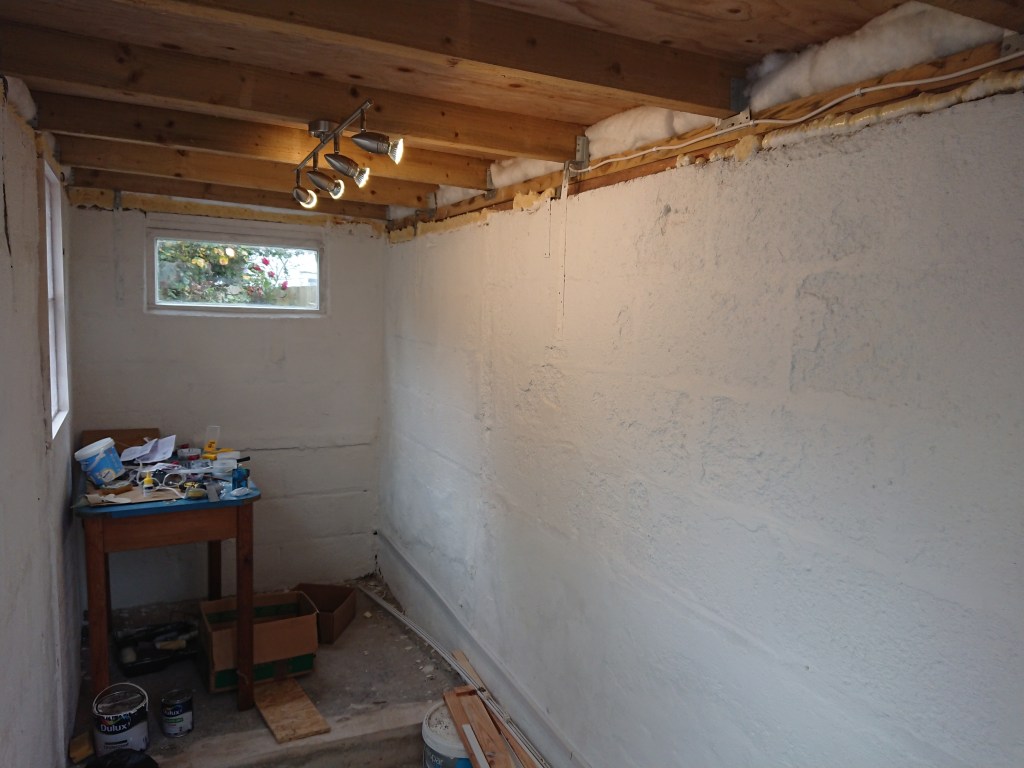
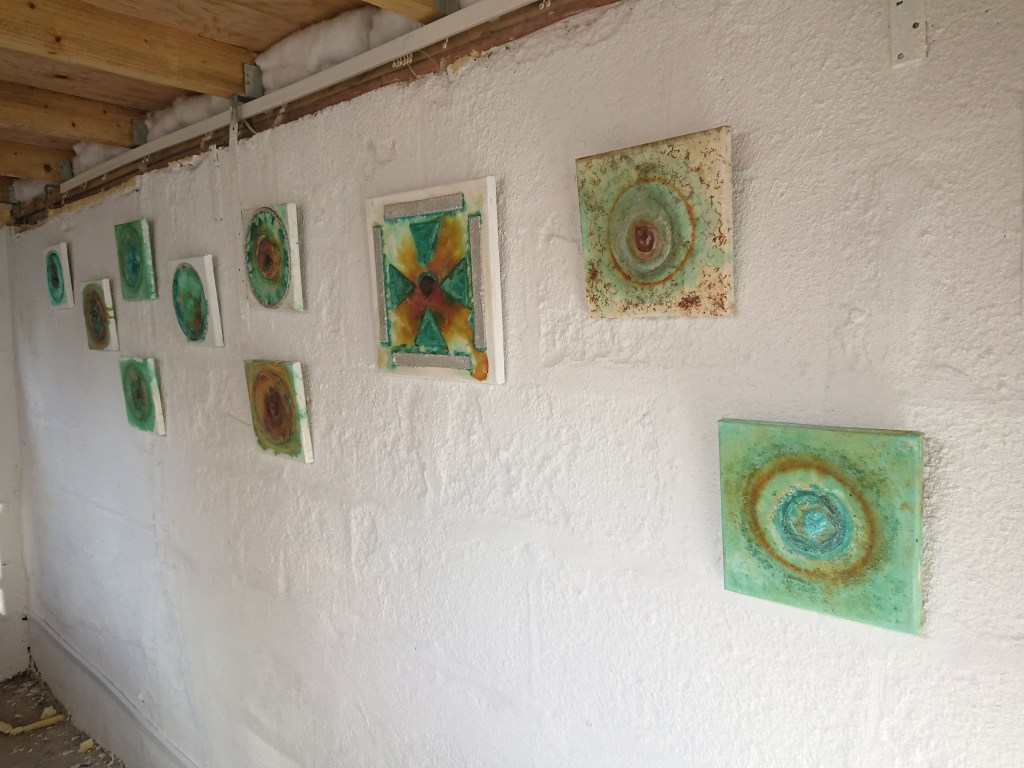
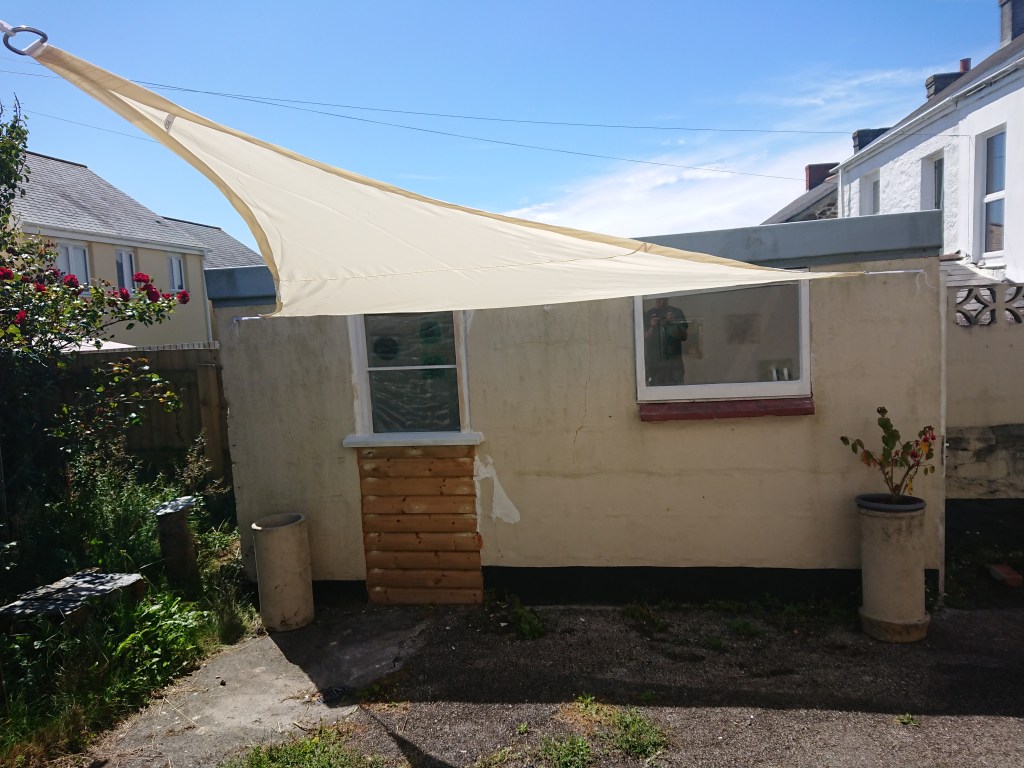
Over the last few weeks I have been transforming my outdoor studio into a small gallery space and hanging the newly created collection of ‘electrochemical paintings’.
A repurposed curtain rail enabled the artworks to be easily re-arranged and the addition of LED spotlights completed the transformation from studio to gallery.
If it happens to be too sunny or raining, there is a shade/umbrella for visitors waiting to go inside the studio gallery (1 in, 1 out).
“The name Redruth is said to be derived from the fact that by the 14th century the stream running along the bottom of Fore Street was so discoloured with iron oxide from tinning activities that it ran red. Hence Redruth, the Cornish for ford is Rhys and red is Ruth.” http://www.visitredruth.co.uk/History_of_Redruth_3146.aspx
“Located on the Great Flat Lode, a rich and accessible body of copper and tin ore, and just three miles from port of Portreath, Redruth was home to the full range of mining society. Walk along the residential areas to the south of the town centre, and you will be welcomed by the grand Victorian architecture which was home to mine owners and others who had profited from Cornish tin.” http://www.visitredruth.co.uk/About_Redruth_3116.aspx
“Redruth boomed because of mining in the area. In 1823 it was said that Redruth: ‘derives its whole importance from its central situation with respect to the mines’. However after 1866 the price of copper fell dramatically and copper mining went into decline.” http://www.localhistories.org/redruth.html
Copper and iron are essential elements in my work, and having recently moved to Cornwall, the possibility of finding raw copper minerals, became a quest!
What do they look like, what are they made of, where might I find some?
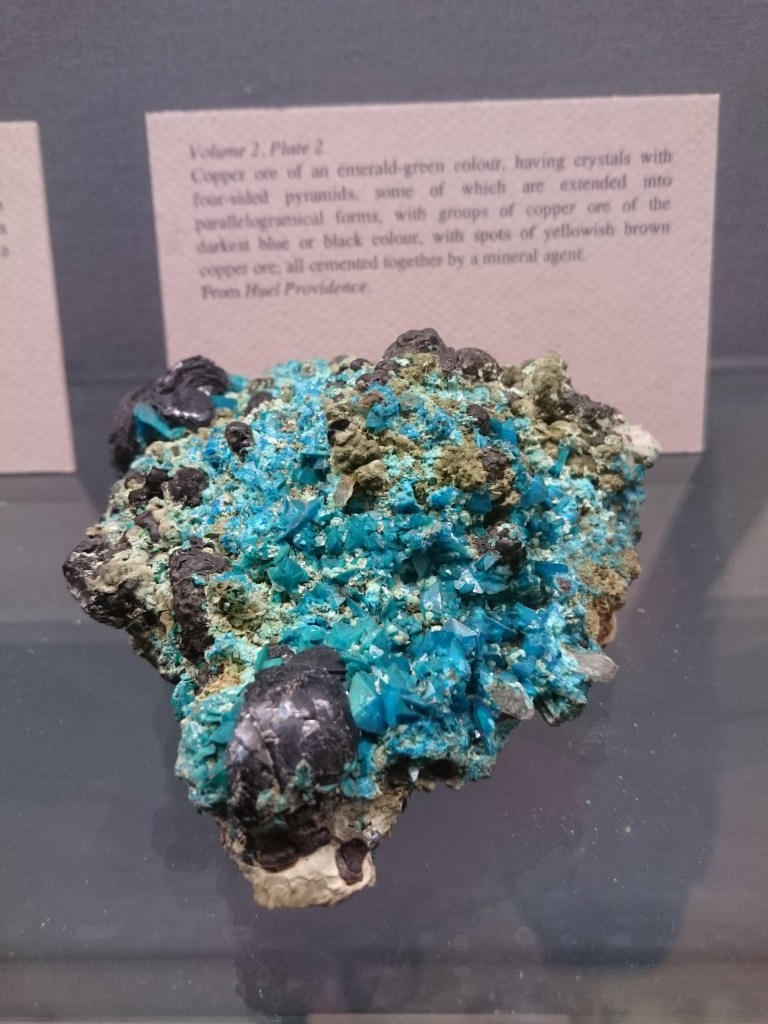
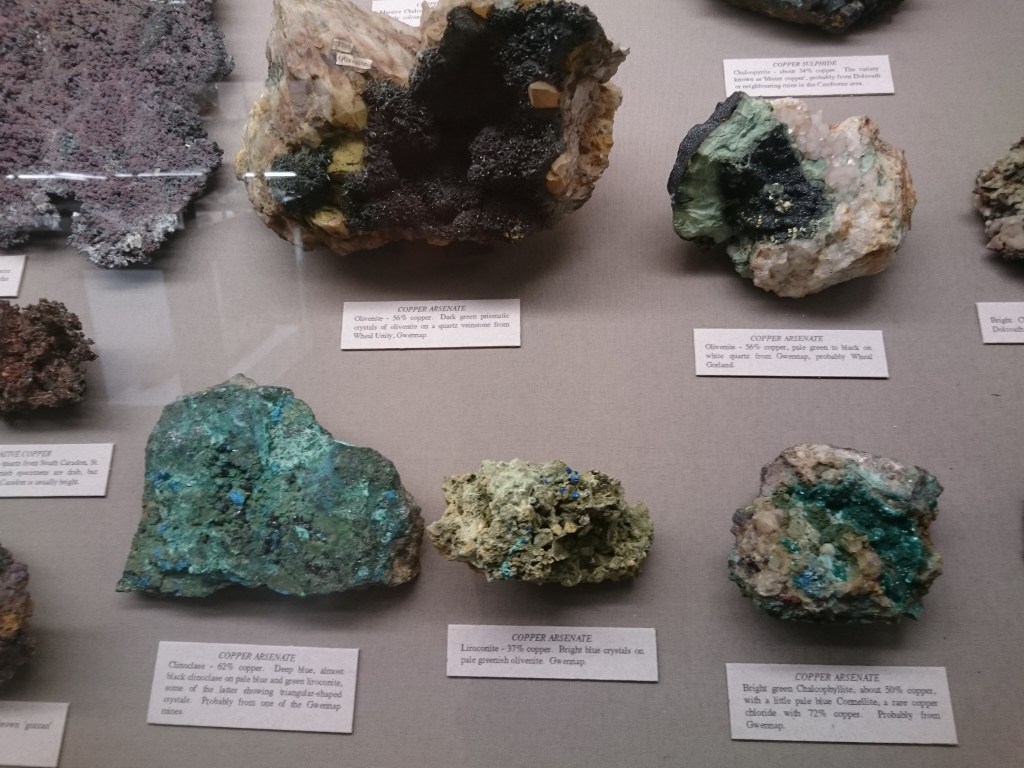
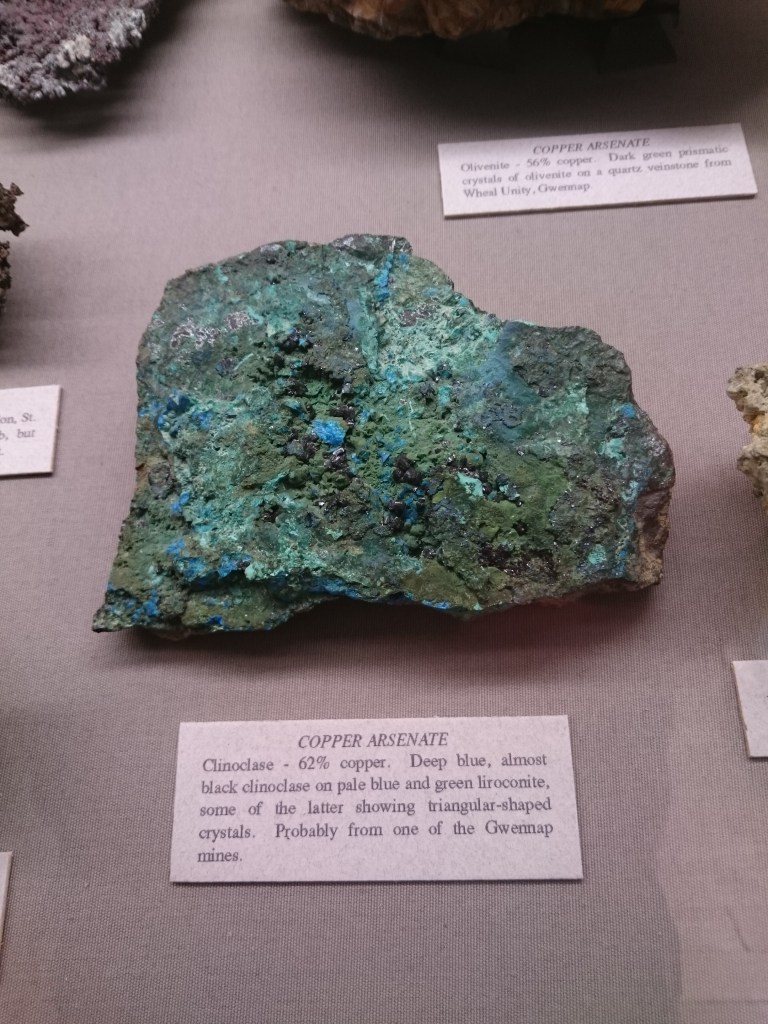
Some of the more beautiful copper minerals are collectors items:
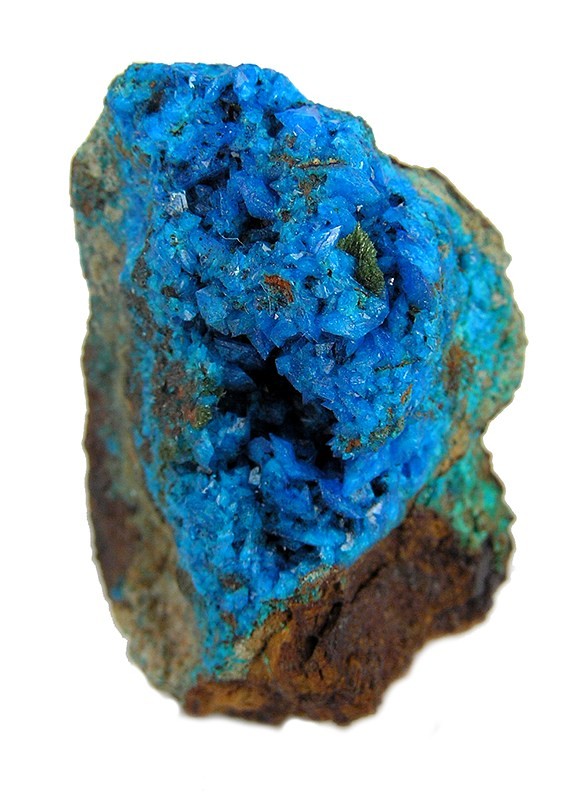
Liroconite from
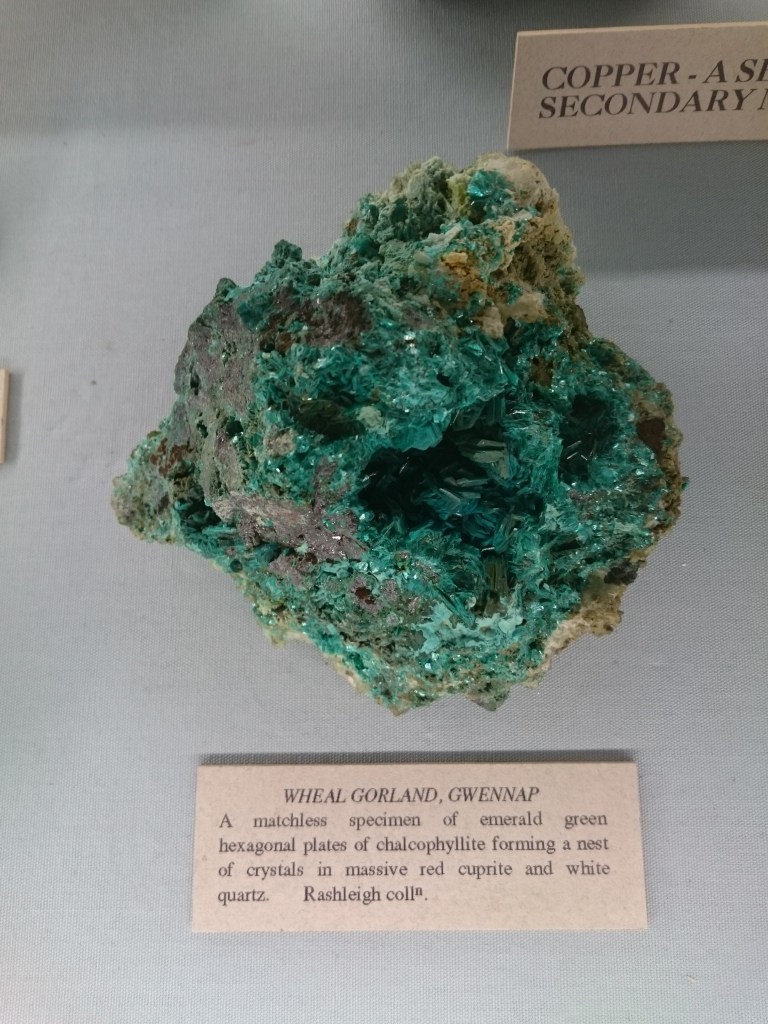
Wheal Gorland

The names of most Cornish mines are prefixed with Wheal, such as Wheal Jane, Wheal Butson, etc. its Cornish for a place of work.

Wheal Gorland
St Day United Mines (Poldice Mines), Gwennap area, Camborne - Redruth - St Day District.
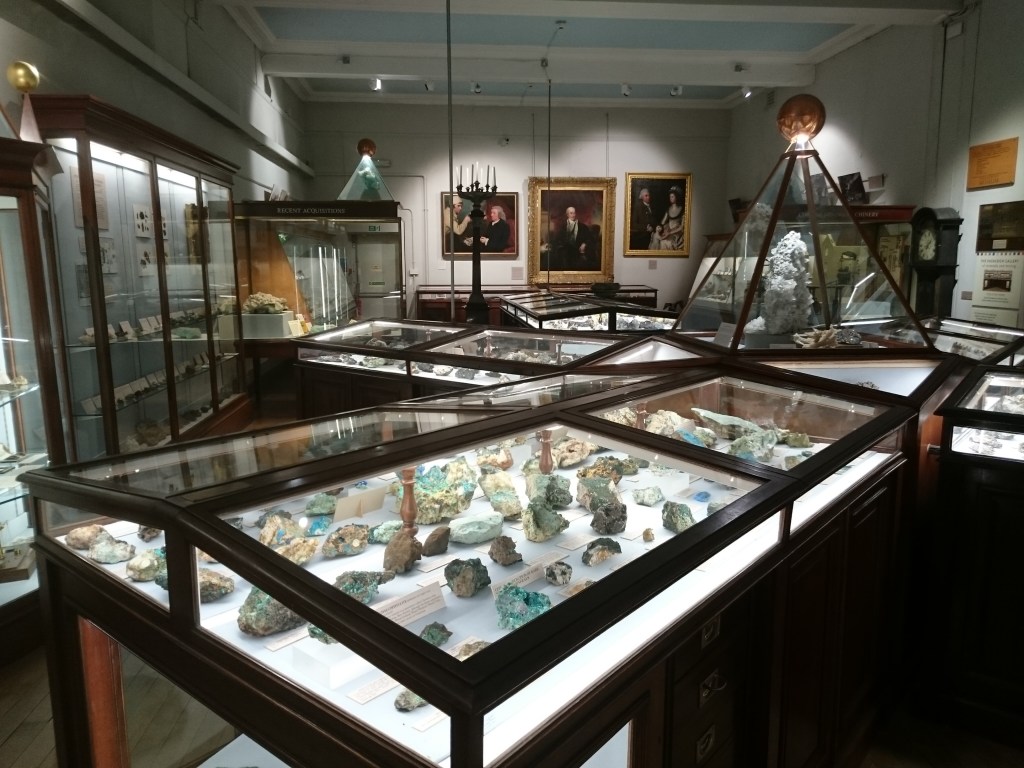
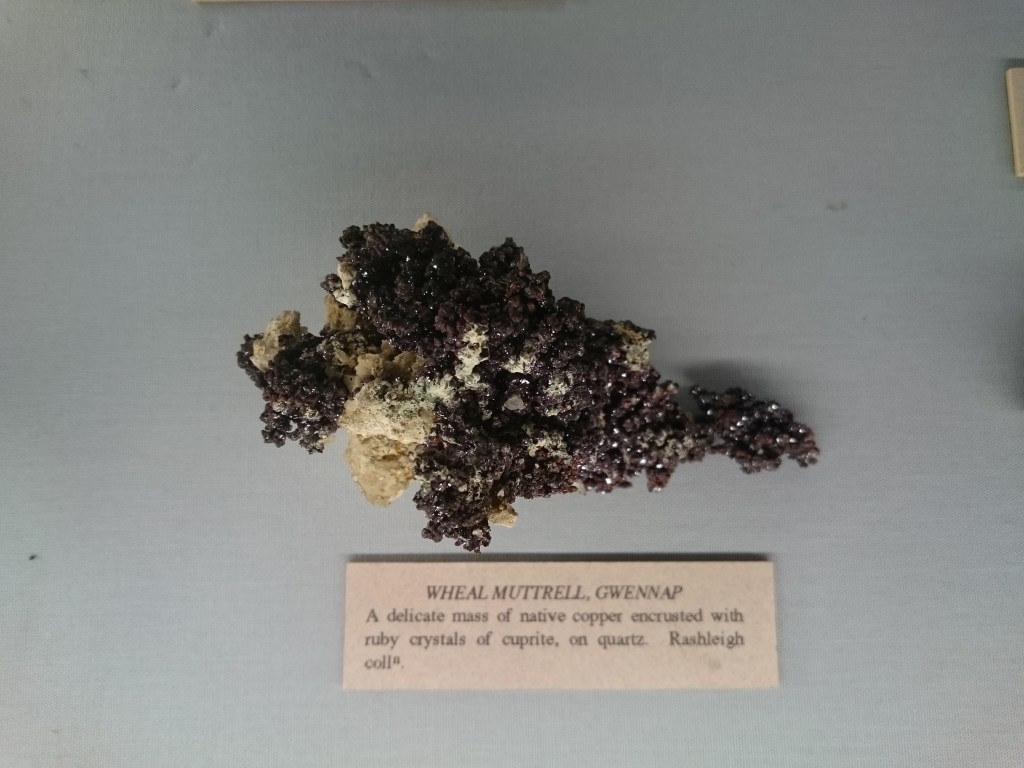
Rashleigh began collecting around 1760 and his wealth, his contacts with local mine owners and captains and his acquaintance with other collectors, dealers and mineralogists in the UK and Europe ensured his substantial collection.
An intricate dendritic growth of copper crystals. Also known as native copper, the specimen is pure copper, uncombined with any other elements. Some of the best dendritic (branching) specimens came from the Gwennap mines and, although the locality for this specimen is unknown, it is probable that it came from one of these mines, perhaps Wheal Unity. Copper lodes are widespread in Cornwall and, as a result, copper was one of the most significant metals mined in Cornwall.
I began searching to see where and what I might find copper rocks or minerals. I tried a cave in St. Agnes, I looked around derelict engine houses and the spoils of the Wheals on the North Coast.
In mining, overburden (also called waste or spoil) is the material that lies above an area that lends itself to economical exploitation, such as the rock, soil, and ecosystem that lies above a coal seam or ore body.
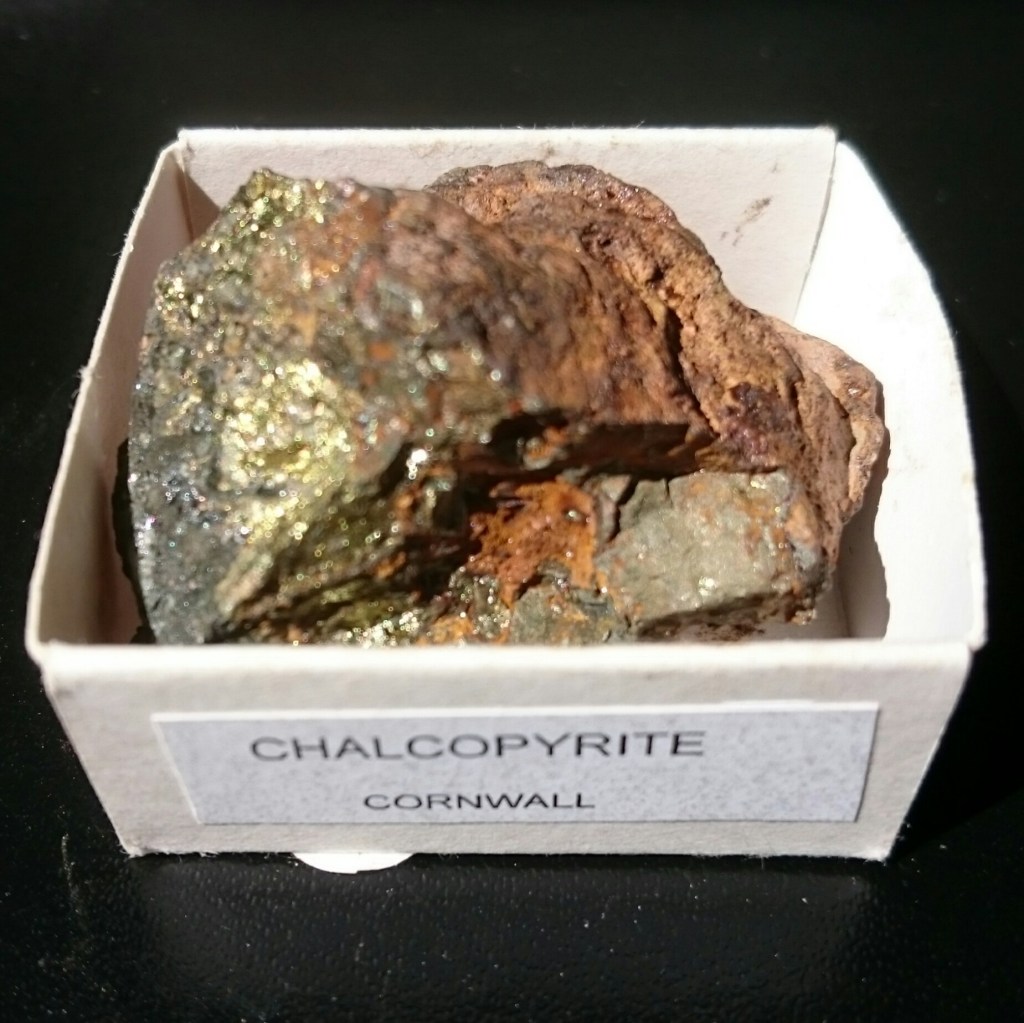
I found nothing, apart from some blue water at the bottom of cliffs, suggesting copper was around. The museum at St. Agnes happened to have a two Cornish copper mineral samples for sale, which I snapped up.
Chalcocite and Chalcopyrite
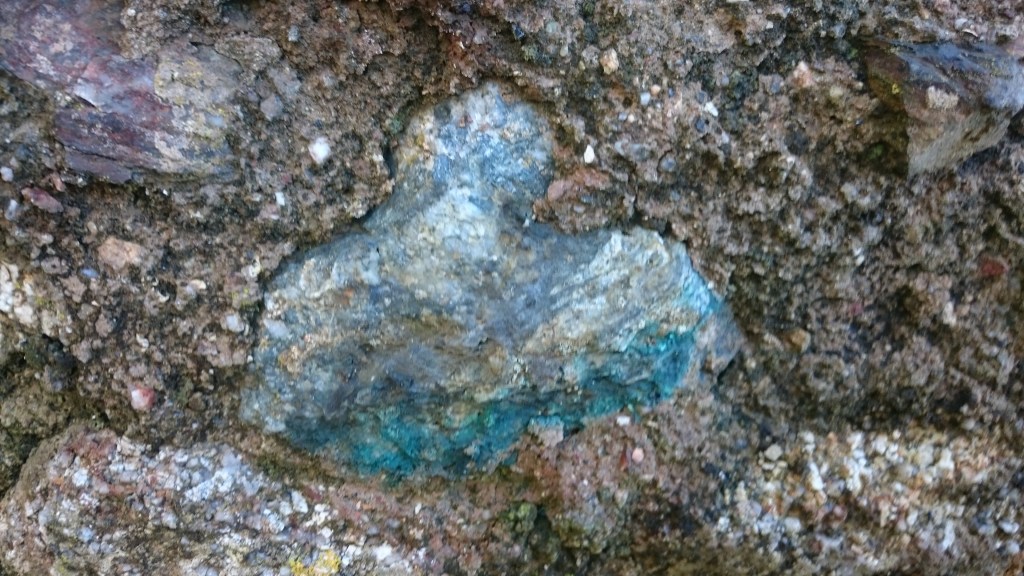
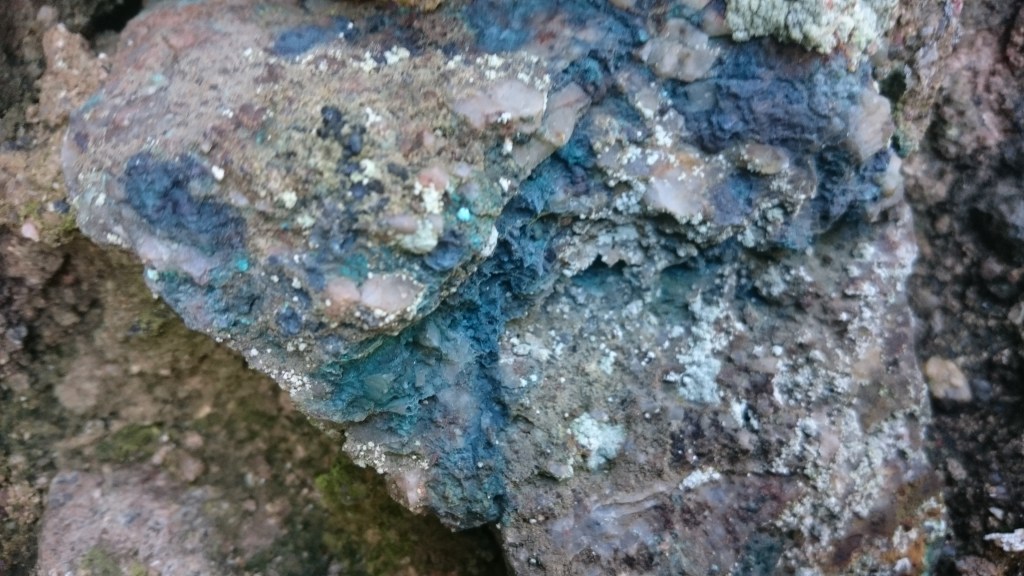
Later in my travels around the Great Flat Lode, in the structures of the old mining buildings, I found blue tinged rocks, indicating the presence of copper.
I found an interesting looking rock on a bike ride around Bassett Wheal on the Great Flat Lode, but then became rather worried after reading that the mined mineral Bassettite, was radioactive, containing uranium.
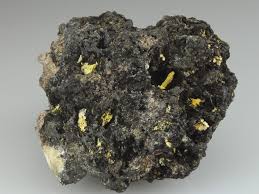
Bassettite, named in 1915 by Arthur Francis Hallimond after the Basset Mine group, Cornwall, England, UK, from which the mineral was first described.
Bassetite, an uncommon secondary mineral occurring in the oxidized zones of uranium-bearing hydrothermal mineral deposits is Radioactive as defined in 49 CFR 173.403. Greater than 70 Bq / gram.
To be safe when collecting rocks, I bought a portable Geiger counter and measured the rock I had found, it was safe at around 40 counts per minute.
Now I wanted to find a rock that was radioactive and went exploring around the Great Flat Lode. I found a rock in one of the old building structures that made the Geiger counter bleep alarmingly, it was picking up radiation over 100 counts per minute:
Radioactive rock – over 300 counts per minute
The rock itself looked unusual, standing out with a blue colouration, indicating copper, but without the meter I would not know it also contained uranium and was radioactive..
All found rock samples will be tested to ensure that they are safe and not radioactive.
…
Petri Dish Experiments
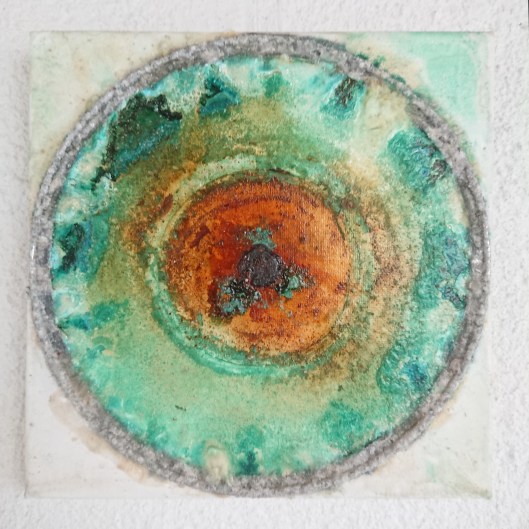
Electrochemical works are created using found local (non-radioactive) copper and ferrous minerals.
An early experimental work using Petri dishes demonstrates the emergence of blue/green – copper and red/orange – ferrous pigmentations from local minerals, illustrated below.
From Saturday 29 August to Sunday 6 September, more than 200 artists, designers and makers will be welcoming socially-distanced visitors into their studios in a celebration of artistic practice, with appropriate safety measures in place.
From Marazion to St Minver, St Ives to Saltash and Penzance to Penwithick, in leafy villages, seaside settlements and wooded valleys, painters, printmakers and potters; textile designers, sculptors and illustrators will guide you between granite gateposts, down gravelled driveways and along ancient footpaths – and to the Open Studios Cornwall website, enhanced with online studio tours and additional digital content by participants who are not able to throw open their doors, for reasons of limited space or personal vulnerability – to discover, discuss and purchase their work.
Curate your own art trail by following those distinctive orange ‘O’s across the Duchy’s creeks, coves and coastlines – or take the virtual route from the comfort of your own home – and support Cornwall’s creative community. Please check the website for the latest information about who is opening and when.



















 The Artifacts of DrB